

The Gender Divide
Over the last few years, it’s become increasingly clear to me that a significant divide is growing between men and women—not only in how they differ, but in how they see themselves and each other. We see it in families, politics, churches, workplaces, and relationships. Although many factors contribute to that division, the deepest problem is that we have moved away from God’s design. When we reject what God created men and women to be, confusion and conflict inevitably follow. We must be restored to our God-given “factory settings.”
In this series of articles, we’re going to see how recovering Biblical manhood and womanhood can shrink the growing gender divide. This article will tackle the lies we’ve come to believe about men; the next will cover how to recover a biblical view of manhood.
False Caricatures of Manhood
One way our culture has departed from God’s design is by replacing biblical manhood with a collection of false caricatures. Men are constantly being told what they are, what they are not, and what they should become.
In this article, we’ll begin by identifying some of the lies our culture has embraced about what it means to be a man. Behind those lies is a deeper spiritual deception that distorts God’s good design. Recognizing those false ideas will give us a clearer framework for turning to Scripture and seeing how God’s Word restores a true and healthy vision of manhood.
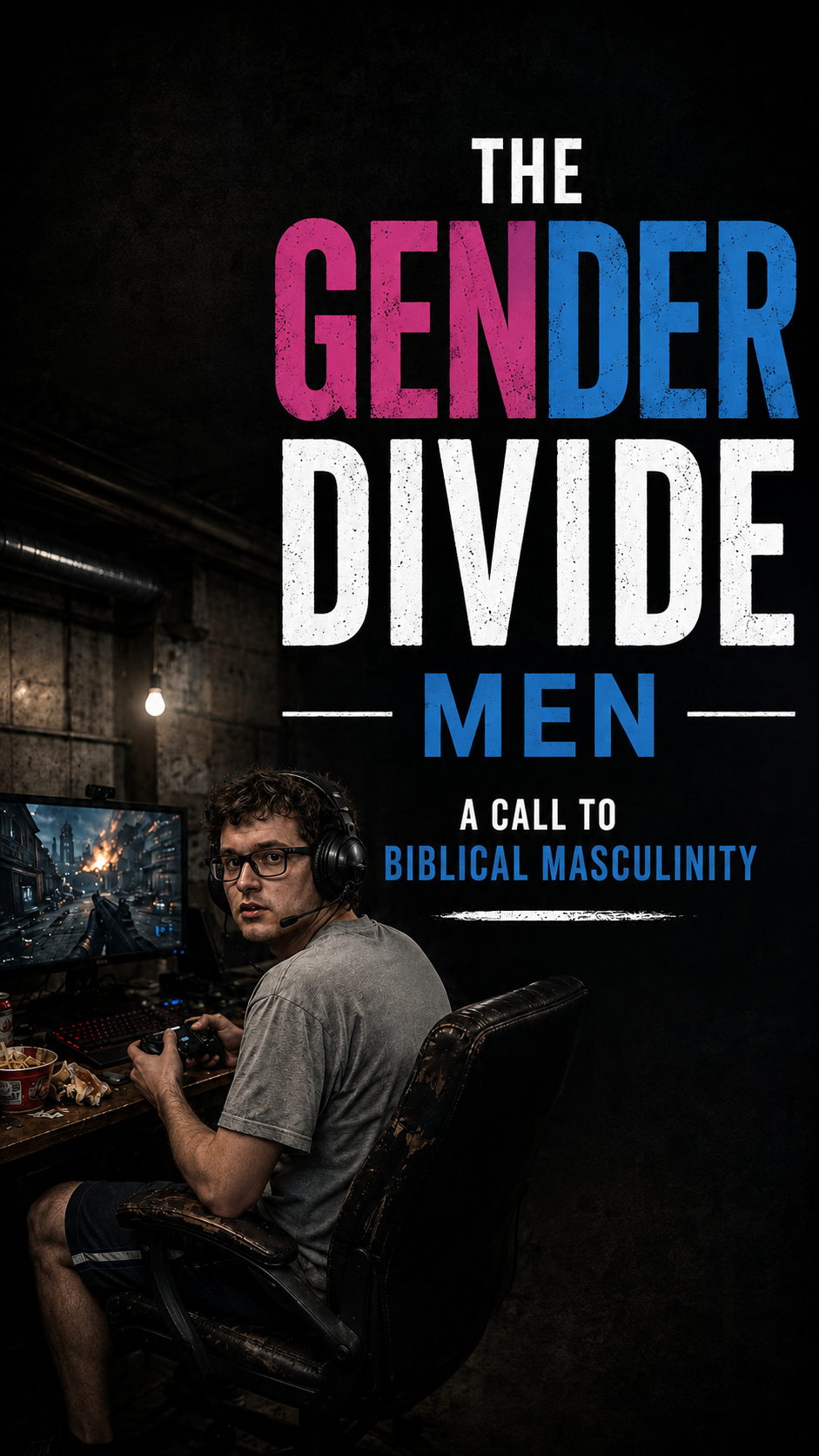
The Sitcom Man
One familiar caricature is the incompetent man—the bumbling sitcom father who is warm and funny but incapable of leading his family.
His children can manipulate him. His wife must rescue him from his mistakes. He may contribute some comic relief, but no one expects him to possess wisdom, exercise discernment, or carry meaningful responsibility.
This picture has been repeated so often that many people have begun to accept it as reality. Men are expected to be immature and unreliable, and men themselves can begin believing that this is simply who they are.
When a culture continually tells men that they are incompetent, some men will eventually stop trying to become competent. The lie begins to produce the very condition it claims merely to describe.
The Toxic Man
At the other extreme is the belief that masculinity itself is toxic.
Men are generally stronger and more physically aggressive than women. God designed men with the ability to carry weight, withstand hardship, and confront danger. Because of sin, however, that strength can be corrupted. Some men use their power to dominate, intimidate, abuse, or harm those who are weaker.
Such behavior is wicked. Scripture never excuses violence, cruelty, or selfish domination.
The cultural lie, however, goes further. It suggests that men are dangerous simply because they are men. Masculine strength, aggression, and authority are treated as problems that must be suppressed.
But strength is not the enemy. Strength must be disciplined and directed toward godly purposes. A boy’s strength can develop into destructive selfishness, or it can mature into the courage of a protector. The answer is not to eliminate masculine strength but to bring it under the control of Christ.
The Soft or Effeminate Man
While one part of culture portrays men as dangerously aggressive, another encourages men to abandon the qualities that distinguish them as men.
Masculinity is sometimes treated as an embarrassment. Men are encouraged to soften every edge, avoid firmness, and blur the distinctions between manhood and womanhood.
This does not mean that men should be emotionally distant, harsh, or incapable of tenderness. Jesus Christ displayed compassion, grief, patience, gentleness, and sacrificial love. Biblical masculinity is not emotional emptiness.
At the same time, Scripture does not treat the distinctions between men and women as meaningless. God created mankind male and female. Those distinctions are purposeful, good, and worthy of being reflected in the way we live.
A man does not become more godly by imitating femininity. He becomes more godly by displaying the character of Christ as a man.
The Purposeless Man
Another common caricature is the man without direction.
He spends years waiting to discover himself. He talks about finding his purpose but avoids taking responsibility. He remains motionless because he is afraid of choosing the wrong path. There is certainly value in prayerfully considering God’s direction. But men often discover their calling while they are already working, serving, learning, and carrying responsibility.
Purpose is rarely discovered through endless self-examination. It is ordinarily developed through faithful action. A man should not sit at home waiting for a perfect sense of certainty before doing something meaningful with his life. He should work. He should serve. He should accept responsibility. He should become useful in his home, church, workplace, and community
God frequently directs people who are already moving in obedience.
The Immature Man
I grew up hearing this called the peter-pan syndrome, “I don’t want to grow up.” We’ve placed such a cultural premium on youth that we’ve dismissed the value of growing up, making responsible decisions, and having wisdom beyond our years. Boys that grow up to be bigger and older boys forget about the need to grow up. When boys become men, they put away childish things (1 Cor. 13:11).
The Domesticated Man
The harmless man is pleasant, passive, and unwilling to lead.
He may be physically present in the home, but he carries little spiritual or relational responsibility. He waits for someone else to make the difficult decisions, initiate important conversations, discipline the children, or guide the family toward Christ. A passive man may avoid conflict, but he also leaves burdens for others to carry.
The Alpha-Male
Because our culture has often mocked and weakened men, some voices have reacted by promoting an equally distorted version of masculinity.
According to this caricature, a real man must be physically imposing, sexually successful, financially extravagant, verbally aggressive, and emotionally untouchable. He proves his manhood by dominating other people.
This is not biblical masculinity. It is pride wearing masculine clothing. The biblical man is not obsessed with proving that he is the strongest person in the room. He uses whatever strength God has given him to serve, protect, build, and love.
True masculinity is never separated from holiness.
The Gross Man
Men are also frequently portrayed as morally filthy by nature.
Certainly, many men have surrendered to sexual temptation. Our culture surrounds men with sensual images, pornography, and opportunities to indulge lust. Men who participate in those sins are responsible for their choices and must repent.
But it is also wrong to assume that every man is secretly immoral or incapable of purity.
Many Christian men are fighting serious battles to guard their eyes, discipline their thoughts, and walk in holiness. They desire to love one wife, raise a family, and honor God with their bodies.
Men should not excuse impurity by claiming that lust is simply part of being male. Women should not assume that every man is controlled by corrupt desires. God calls men to purity, and through the power of Christ, purity is possible.
The Disposable Man
Another message tells men that they are no longer needed.
According to this view, men are unnecessary in the home, harmful in leadership, and largely expendable in society. Their influence is something to minimize rather than cultivate.
But men are not disposable.
Homes need godly fathers. Churches need faithful male leadership. Communities need men who work, protect, teach, provide, and serve. Women and men are equally created in the image of God, but equality does not make either sex unnecessary.
When good men withdraw, destructive men do not disappear. Instead, vulnerable people are left without the protection and leadership that faithful men should provide.
The Isolated Man
Finally, there is the self-sufficient man.
He needs no one. He asks for no help. He carries every burden privately and refuses meaningful relationships with other men. If society rejects him, he simply retreats into isolation.
This may look strong, but it often hides pride, fear, or discouragement.
God did not create men to live without community. Men need friendship, accountability, mentorship, and fellowship. Younger men need older men who can model wisdom and faithfulness. Older men need opportunities to invest in those who follow them.
Isolation does not make a man strong. It often leaves him vulnerable to temptation, bitterness, and despair.
Rejecting Satan’s False Caritcatures
The cultural messages surrounding manhood are confusing because they pull men in opposite directions.
Men are told they are too strong and too weak, too dominant and too passive, unnecessary yet responsible for every problem. They are mocked for failing to lead and criticized when they attempt to lead.
These contradictions should remind us that culture cannot provide a stable definition of manhood. Its standards change with every generation, movement, and trend.
We must return to something more permanent. The answer is not to choose our favorite cultural caricature. It is not to revive a nostalgic picture of manhood from a previous generation. It is not to replace passive men with arrogant men or weak men with cruel men.
The answer is to return to God’s design.
Men must recognize the lies they have been told and refuse to build their identities upon them. Women must also reject distorted assumptions about men and learn to recognize the difference between selfish domination and godly leadership, between uncontrolled aggression and courageous protection, and between emotional coldness and masculine strength.
Culture has produced a confusing web of counterfeits. Scripture gives us something far clearer.
God has called men to be workers and protectors. That is the calling we’ll consider in the next article.
This article is adapted from a sermon preached in our “Understanding our Times” series. You can view that here.