
Enslaved by the Scroll

What if you’re addicted—and you just haven’t noticed yet?
One of the defining issues of our generation is technology. Technology makes for a powerful tool, but a horrible master. Smartphones, social media, streaming services, gaming, and constant connectivity have reshaped nearly every aspect of life. Like every major technological advancement throughout history, these tools must be evaluated through a biblical worldview.
The question is not whether technology exists. The question is whether we will use it wisely, or allow it to use us.
Seeing Technology for What it Is
If you’re reading this, you’re probably the kind of person who can easily list the legitimate benefits and dangers of smartphones, social media, and other internet technologies. You already know technology offers tremendous benefits: it allows us to communicate instantly, access information, share the gospel, and stay connected across great distances.
At the same time, Christians must be honest about its dangers. There are many you could name, but let’s dig deeper into a few issues we may not readily acknowledge.
Technology Addicts Us to Distraction.
Many people check their smartphones dozens or even hundreds of times per day. What was once an occasional tool has become a constant companion.
Scripture warns us against being mastered by anything:
“All things are lawful unto me, but all things are not expedient… I will not be brought under the power of any.” (1 Corinthians 6:12)
God created us with the ability to focus. Paul described the Christian life as a race that requires singular concentration:
“This one thing I do…” (Philippians 3:13)
Modern technology often works against that focus. Social media platforms are intentionally designed around cycles of triggers, rewards, and cravings that keep users coming back for more. Over time, these habits can reshape the way we think and pay attention.
The ability to concentrate is a gift from God. We should guard it carefully.
Technology Artificializes Relationships.
Jonathan Haidt notes that Gen Z became the first generation to go through adolescence with a smartphone constantly in their pocket.
As online interaction increased, face-to-face interaction decreased dramatically.
While technology can connect people, it can also replace genuine relationships with curated versions of reality. We can surround ourselves with people who think exactly like we do while avoiding the challenges and blessings of real human interaction.
God created us for embodied relationships—not merely digital ones.
Technology Erodes Deep Thinking.
Many people have noticed a troubling reality: thoughtful conversation seems increasingly difficult.
Constant interruptions fragment attention. Endless scrolling conditions us to consume information rapidly without reflecting deeply.
Yet Scripture repeatedly calls believers to be sober-minded:
“For God hath not given us the spirit of fear; but of power, and of love, and of a sound mind.” (2 Timothy 1:7)
“Be sober, be vigilant…” (1 Peter 5:8)
Christians must be people who think clearly, reason carefully, and discern truth faithfully.
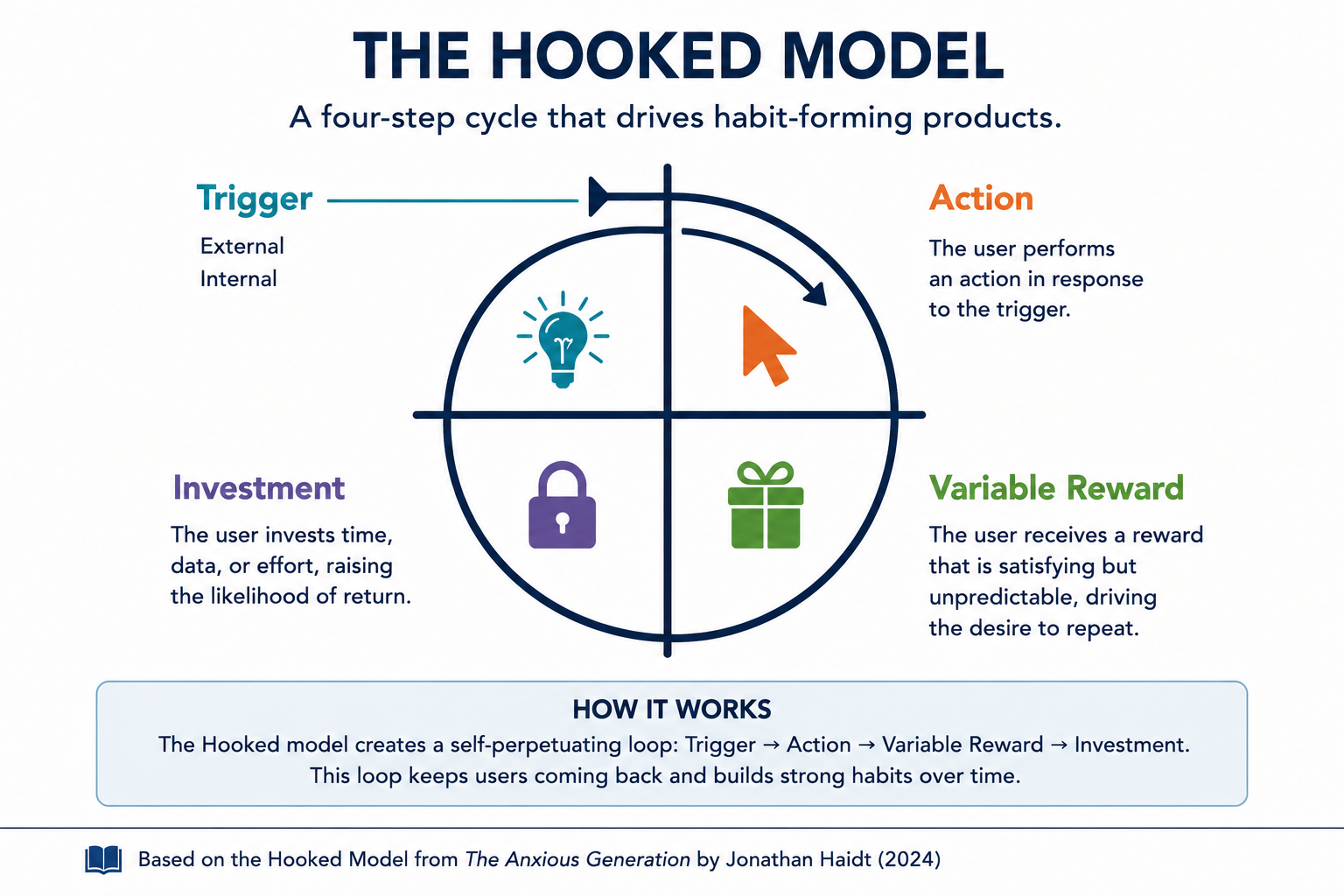
This model is an enhanced version of the model provided in Jonathan Haidt’s “The Anxious Generation.”
Technology Attacks Men and Women Differently.
While the underlying dangers are similar, technology often targets men and women in unique ways.
For many women, social media can become a breeding ground for comparison, approval-seeking, envy, and image-consciousness.
Scripture reminds us:
“Comparing themselves among themselves, are not wise.” (2 Corinthians 10:12)
“Favor is deceitful, and beauty is vain: but a woman that feareth the Lord, she shall be praised.” (Proverbs 31:30)
For many men, technology offers different temptations: gaming addiction, pornography, isolation, and virtual escape.
God created men to work, build, lead, and serve. Yet many settle for digital substitutes that provide the feeling of accomplishment without producing anything of lasting value.
Paul exhorted believers:
“Work with your own hands.” (1 Thessalonians 4:11)
God calls men and women alike to pursue godliness over digital distractions.
Technology Inundates Us with Temptation.
Never before have so many temptations been so accessible.
With a few taps, we can encounter envy, lust, anger, foolishness, vanity, and endless distractions.
Our enemy understands this reality.
Christians cannot afford to be naïve about the spiritual dangers that exist in their pockets.
Technology Fuels Anxiety and Dissatisfaction.
Studies consistently show rising rates of anxiety, depression, loneliness, and dissatisfaction among young people in the smartphone era.
The more we seek fulfillment through digital experiences, the more dissatisfied we often become.
Technology promises connection while increasing loneliness. It promises entertainment while producing restlessness. It promises satisfaction while creating craving.
Valuing What Technology is Stealing
What exactly are we losing when we fall pray to the addictive nature of technology and social media?

Single-Mindedness
The Christian life requires focus. In God’s Word, it’s described as being a “sound-minded” or “sober-minded person.” When our focus is on our Savior and His Word, we can have a sharpened focus and perspective.
“Looking unto Jesus the author and finisher of our faith.” (Hebrews 12:2)
Distractions have always existed. Yet believers must learn how to keep their eyes fixed on Christ amid a world competing for their attention.
Holiness
Technology often places temptation directly in front of us.
Scripture’s response is clear:
“Flee also youthful lusts.” (2 Timothy 2:22)
“Abstain from fleshly lusts, which war against the soul.” (1 Peter 2:11)
God never calls us to negotiate with temptation. He calls us to flee from it.
Eternal Perspective
Technology trains us to focus on what is immediate, visible, and temporary.
God calls us to focus on eternal realities.
“Set your affection on things above, not on things on the earth.” (Colossians 3:2)
“The things which are seen are temporal; but the things which are not seen are eternal.” (2 Corinthians 4:18)
Christians live by faith, not by notifications.
Christlikeness
We become like what we admire.
Psalm 115 teaches that those who worship idols become like them.
The same principle applies today. We are shaped by what we continually behold.
If our attention is constantly directed toward vanity, self-promotion, outrage, and entertainment, we should not be surprised when those things begin shaping our hearts.
God's Approval
Many people spend enormous amounts of energy seeking validation online.
Yet Paul asked a crucial question:
“For do I now persuade men, or God?” (Galatians 1:10)
The opinion that ultimately matters is not the approval of followers, friends, or strangers.
It is the approval of God.
Stillness and Solitude
Many people have forgotten how to be alone with their thoughts.
Yet some of the deepest moments of spiritual growth occur in quietness.
“Be still, and know that I am God.” (Psalm 46:10)
The constant noise of technology often drowns out the very moments when God wants to speak through His Word and Spirit.

Growing Intentionally in Christ
Master Your Technology.
Don’t allow your devices to master you. Limit notifications. Remove unnecessary apps. Create barriers between yourself and your biggest temptations.
Technology should remain a tool, not a master.
Establish Healthy Rhythms.
Build intentional routines into your day.
Guard your mornings and evenings. Set boundaries for social media and entertainment. Create habits that encourage spiritual growth rather than distraction.
Practice Solitude.
Spend time without constant stimulation. You don’t need to be constantly entertained.
Take walks. Sit quietly. Pray. Reflect. Allow your mind to slow down enough to hear God’s voice through His Word.
Fast from Technology.
Sometimes the best way to reveal an unhealthy dependency is to remove it temporarily.
A technology fast can expose hidden addictions and create space for spiritual renewal.
Choose Creation over Artificiality.
Go outside.
Look at the stars.
Take a walk.
Build something.
Create something.
Become a reader.
Reading develops concentration, patience, and depth of thought.
Imagine how your life would change if you replaced hours of scrolling with hours of reading.
Prioritize Real People.
Technology should never replace face-to-face relationships.
Invest in your family. Spend time with friends. Have meaningful conversations.
People are not interruptions to life; they are one of God’s greatest gifts.
Use Your Paper Bible.
For many believers, using a physical Bible can help eliminate distractions and improve focus during personal devotions and church services.
There is tremendous value in opening God’s Word without the temptation of notifications just one tap away.